Victory at IKEA

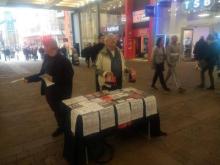
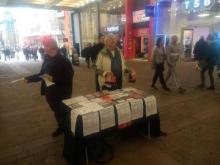
The IKEA store in the city of Brescia sacked 7 store employees in September 2008 refusing to renew their contract with them. The company believed that employees should pay for the crisis. These people had worked at
IKEA for many years, working up to 200 hours per month for as little as 1000 Euros. So the workers decided to protest against this sacking and engaged in picketing at the IKEA store. They have were an established group of workers Senzatemponedenaro and were willing to fight a stubborn struggle. They also joined the USI, the Italian section of the International Workers Association. They conducted continous weekend pickets at IKEA with many people deciding to boycott the store.

Why do we organise?

Capitalism is shit, oppression is shit - but what can we at SolFed do about it?

We need to change the world we live in - a world where exploitation at work and home, state violence, oppression and inequality run rampant.

We can’t do this as individuals - only mass collective action from across the breadth of the working class can achieve this. This doesn’t need to be controlled by a small handful of self-appointed leaders - but if we want to build a movement that challenges capital, the state and all forms of oppression, we need to get organised.

SolFed is a membership organisation, dedicated to the struggle for improved conditions at work, for liveable housing and communities, and against oppression and bigotry. Ultimately we want to be part of the movement that builds an entirely new world.

Fire survivors and bereaved urge Barnet Group to ‘reconsider’ appointment of Laura Johnson, who pushed for cheaper contractor at Grenfell Tower

Well, well, well, just when you think society cannot become more debased, news comes along that Laura Johnson has been appointed permanent Director of Development and Property at the Barnet Group, which manages the borough's 13,000 council homes. This is the same Laura Johnson who, as Director of Housing at the Royal Borough of Kensington and Chelsea, played a principal role in the cost-cutting that led to the Grenfell fire.

Ron Marsden (1937-2026) Despedida a un compañero que compartió su vida con nosotrxs

Ron MarsdenSi alguna vez has estado en Manchester en el barrio de Disbury y has visto una pegatina de Solidarity Federation en el poste de una farola, lo más probable es que fuese Ron quien la puso ahí. Ron Mardsen nació en Lancashire en 1937 y nos dejó el pasado 21 de agosto de 2026. Deja atrás seis décadas de lucha y compromiso con el anarcosindicalismo, con la lucha sindical basada en el asambleariamo, la acción directa y el antiauturitarismo.

Ron empezó a interesarse por el anarcosindicalismo tras participar en el CND (Campaign for Nuclear Disarmament) y acercarse al anarquismo. Tras mudarse a Manchester, se unió a la Syndicalist Workers Federation (SWF), una organización fundada en 1948 por militantes de la Anarchist Federation of Britain (AFB). En 1979 la SWF daría lugar a al Direct Action Movement (DAM) y en 1994 a la actual SolFed, la sección británica de la IWA/AIT, la internacional anarcosindicalista.

Nuestro compañero fue un militante activo de todos estos grupos. Siempre que pudo acudió a las asambleas y conferencias (a las que solía apuntarse a última hora para frustración de sus compañerxs); siempre con propuestas y abierto a nuevas ideas.

Ron MarsdenEscribió numerosos artículos para el Direct Action, el periódico de la federación; en las reuniones acostumbraba a aparecer con frases o recortes de prensa que mágicamente convertía en artículos para publicar.

Siempre apostó por una visión abierta e inclusiva del anarquismo y el anarcosindicalismo. Se interesó por el anarcofeminismo, por las luchas del colectivo LGTB+ (después de la asambleas, solía acompañar a lxs compañerxs más jóvenes a los bares del Gay Village de Manchester), por el antirracismo y por todo tipo de asuntos, lo que muchas veces implicaba asambleas todas las tardes. Con ello contribuyó a la visibilización y a la apertura de SolFed a otras luchas y colectivos.

Interesado en el diseño, ideó campañas antiautoritarias llenas de creatividad y buen humor. Suyo es el recordado cartel del bote de judías Heinz con la cara de Lenin (57 varieties, all unfit for human consumption), o el manhumorado ratón anticlerical (The Blasphemouse).

Recordaremos a Ron por su energía y su compromiso incombustibles, su simpatía, su apertura de mente y su entrega al anarcosindicalismo. Toda su vida luchó por un mundo mejor y en esa lucha estará siempre con nosotrxs.

Ron Marsden (1937-2026) a farewell to our comrade who shared his life with us

If you saw a Solidarity Federation sticker on a lamppost in Didsbury, the chances are it was Ron Marsden who put it there. Ron, born in 1937 in Lancashire, passed away peacefully on 21 August 2026 after six decades fighting for and promoting anarcho-syndicalism, a revolutionary form of trade unionism based on direct democracy, class struggle and anti-authoritarianism.

Higher Education funding model against workers

Cardiff, Durham, Hertfordshire, Sheffield... the list of struggling HEIs goes on and on. If anything was clear as this stage, it's that the funding model for Higher Education is simply not working. Like most of capitalist or quasi-capitalist ventures, leaving everything to the market is not only wasteful but is also extremely damaging of workers' livelihoods. Young people and others who wish to embark on a University course are increasingly thinking twice about doing so because of mounting costs, often questionable quality as provision is cut to the bone and a future that is as doubtful as the continuance of some universities in the UK.
Once again, as many times before, workers on the front line are doing their best to defend their jobs and provide the "service" that managers expect. Strikes, partial strikes and pickets are robust across the land. The picture, nevertheless, is one of abandonment - first by a political class that is not interested in raising true discerning and combative educational tools for the future and second by supposedly national trade unions that have not even managed to mobilise throughout the country. Individual workers and groups of workers at institutions are more or less left to their own devices... and fates. No national strategy prevails. No joined-up movement to stop the rot has been created. Meanwhile, union officers, often in well-paid positions, maintain their jobs at the expense of high membership fees.
Not only is it time for a mobilisation along the lines of a national strike in the sector, it is also time to embrace a new form of unions based on democratic control and forms of direct action such as the boycott and strikes. Syndicalism historically and today where it is resurgent under the banner of the International Workers' Association (established in 1922) is doing just that. Slowly but surely, we are claiming back what is ours and what we produce through our labour. Join us in the fight.
For base unions, direct action and democratic control! For a fighting union now and social transformation in the future!
SFEU

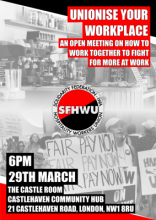
London - Unionise Your Workplace - Open Meeting 6pm Sun 29th March on How to Work Together to Fight for More at Work

We are the Solidarity Federation, a network of local groups who want to take action against bosses, landlords and capitalism.

We want to talk to you about ways you can organise at work that can actually get results, whether the problem is dodgy contracts, missed breaks, pay, or if your boss is a wanker. We believe that organised workers taking action into their own hands is what's needed, not just having to leave your job, having to take it, or going through a big bureaucratic union or HR department.

Come along to talk to organisers from SolFed and connect with local workers to discuss issues that face us at work and in the community and what we can do about it.

Learn more about the Solidarity Federation Hospitality Workers Union (SFHWU) online at solfedhwu.noblogs.org or email us at sfhwu@riseup.net

Crisis after crisis

No-one will doubt that Higher Education is undergoing one of its historic, but it has to be acknowledged, repeated crises. With a drop in international students by some 16% and with approximately 40% of HEIs (Higher Education Institutions) thought to be likely to go into deficit in 2025-2026, university management teams are cutting universities to the bone. Departments supposedly under review face rapid closure or down-sizing, staff in academic support roles have had their positions slashed and whole programmes are disappearing.